
GRUPPENAUSTELLUNG some random spot nearby
04/07/2026 – 29/08/2026
Rosa-Luxemburg-Straße 33
10178 Berlin
Eröffnung / Opening:
Freitag, Juli 3, 2026, 18 – 21 Uhr
Friday, July 3, 2026, 6 – 9 pm
Öffnungszeiten / Opening hours:
Dienstag - Freitag 11 – 18 Uhr, Samstag 12 – 18 Uhr
Tuesday - Friday 11am – 6pm, Saturday 12 – 6pm
Press Release
Till Krause
Mirjam Thomann
Mark Dion
Starting point for the group exhibition some random spot nearby is the publication Travel Bureau by Mark Dion and Daniel Maier-Reimer[1]. The book, perceived as a manifesto of focused observation, is dedicated to the collaboration between the two artist friends. When Dion was invited by Maier-Reimer to present and reflect upon Maier-Reimer’s art, which consists of journeys often documented in a single photograph, Dion decided to present four of the artist’s travels: Lapland Autumn 1990, Kaliningrad Peninsula 2001, Tyrrhenian Sea to Adria 2013 and Journey to Mount Etna 2022. This resulted in Travel Bureau, a spatial installation conceived as a travel agency. Each of its four sides was dedicated to one of Maier-Reimer’s four journeys and included countless assembled objects related to these travels, as well as the four images taken by Maier-Reimer during each trip. Travel Bureau was exhibited at Clages Gallery in Cologne in 2023[2].
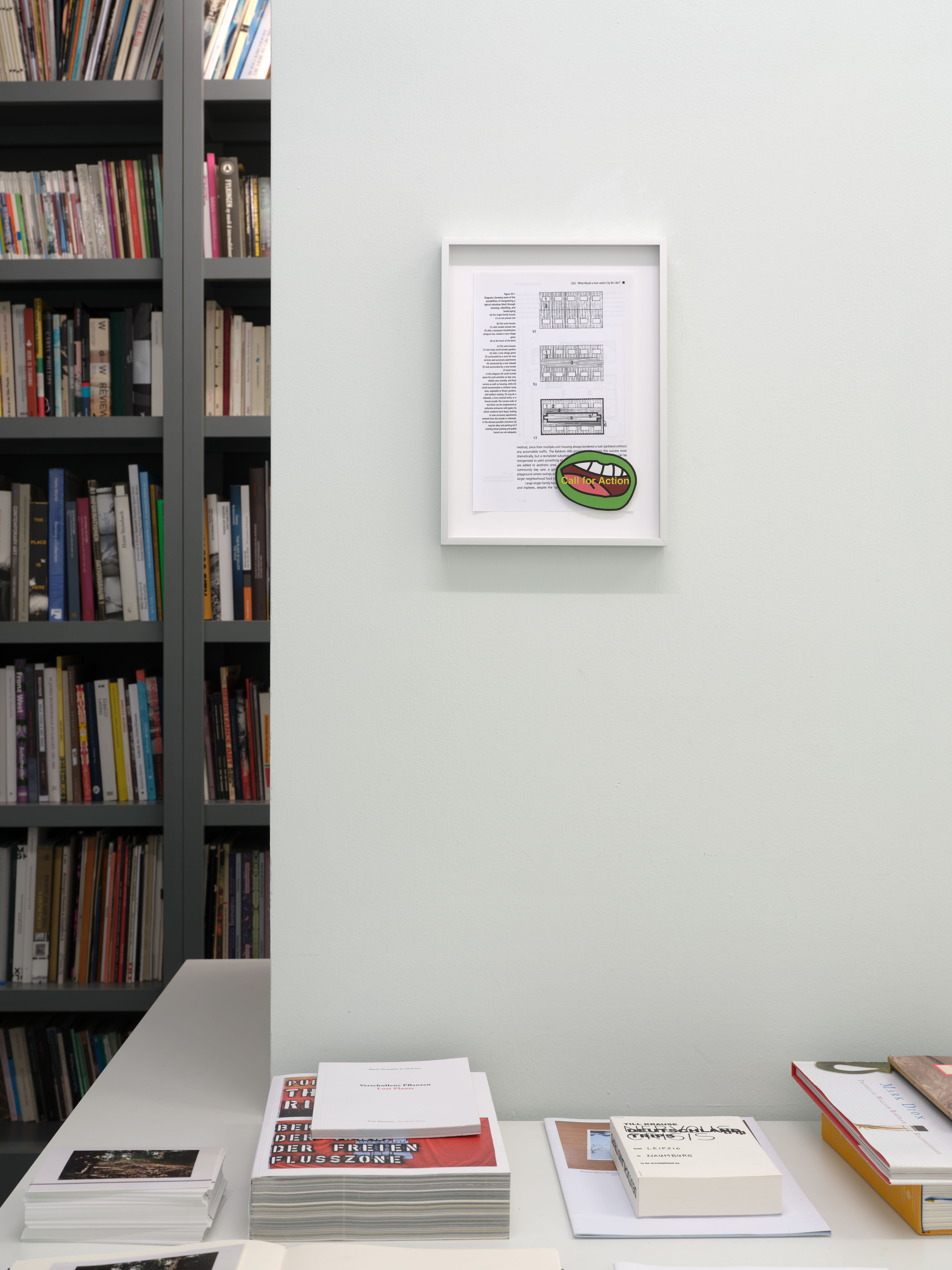
The importance of creative collaboration played a further role when Dion and Maier-Reimer invited Till Krause to design the publication with the aim of documenting Travel Bureau in a book. Drawing on the four-part structure of Dion’s installation, four authors, including Mirjam Thomann, were commissioned to respond to one of four journeys. This group exhibition then, in turn, brings together three artists from the gallery who played a role in the making of the publication. In a simple approach, each artist has developed their contribution to the book into something new for the exhibition. The exhibition title comes from a sentence in Thomann’s text Dear D. for the book on Maier-Reimer’s processes of orientation in space. In it, Thomann draws directly from her own research, combining quotations from art and cultural studies, feminist and architectural theory, autofiction, and social media posts with passages the artist herself wrote. The re-photographed image on the invitation card for the exhibition is by Maier-Reimer and belongs to one of the four journeys Mark Dion presented in his installation Travel Bureau at Clages Gallery. In this way, subtle variations of artistic collaborations emerge, and the exhibition can be read as a manifestation of creative exchange, where collaboration first led to the book and now continues into new works and their constellation within the exhibition, where meaning is derived from ideas interconnecting.
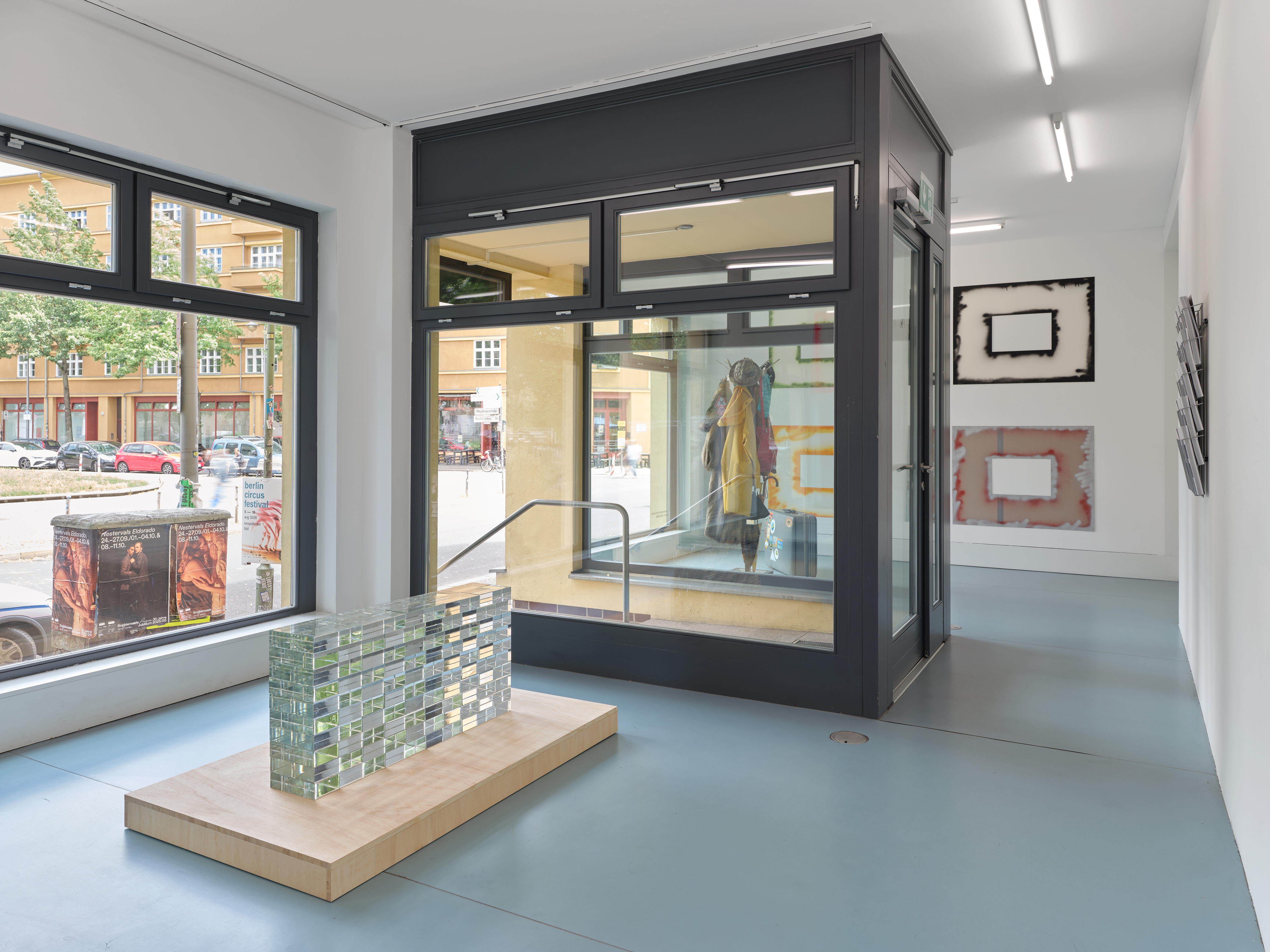
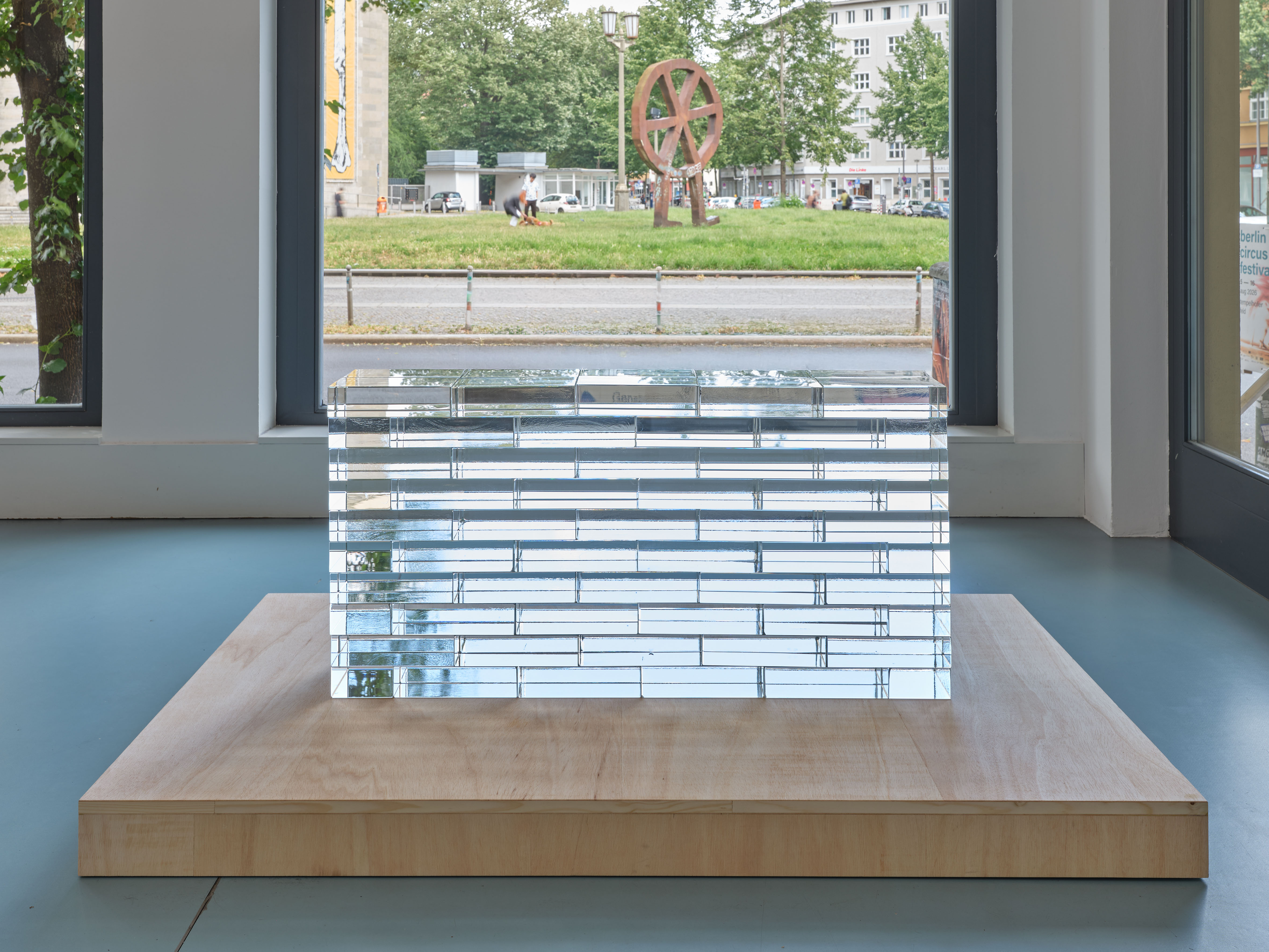
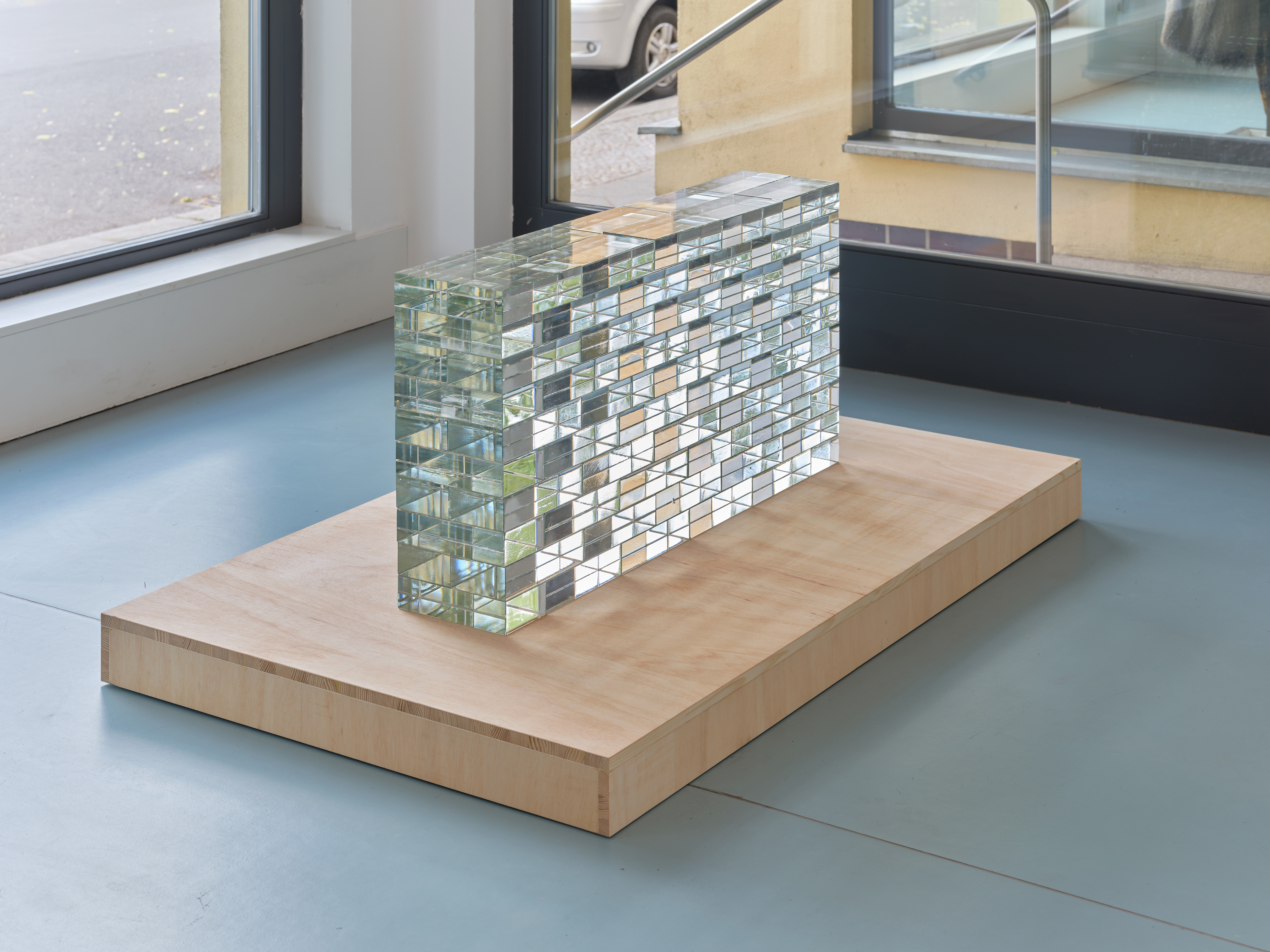
With Wall (2026), Mirjam Thomann presents a new sculpture that builds on a series of works she has developed in recent years, named after basic architectural elements from which spaces are constructed: Column, Step, Wall, Window, Door, Plinth. In exhibitions at Klosterruine, Berlin (2022) or at Galerie Nagel Draxler (2023), bricks and structural elements have been recurring motifs that now reappear in her latest piece. For Wall, Thomann loosely stacked solid transparent glass bricks, that refract and diffuse light, on a wooden plinth close to the window, thus the work can be seen on eye level from the outside. “Bricks create spaces, organize relationships, and store relational knowledge”, reads a text accompanying Harun Farocki’s film In Comparison (2009). As a material used around the globe in the creation of space since the dawn of dwelling, Thomann interrogates the sociopolitical and architectural conditions of this spatial construction in various media and materiality. Thomann’s practice is grounded in close engagement with the existing structures within which her works are created. Through the mediums of installation, sculpture, drawings, and text, she reflects on and transcends the social, institutional, and architectural orders of spaces and their potential use.
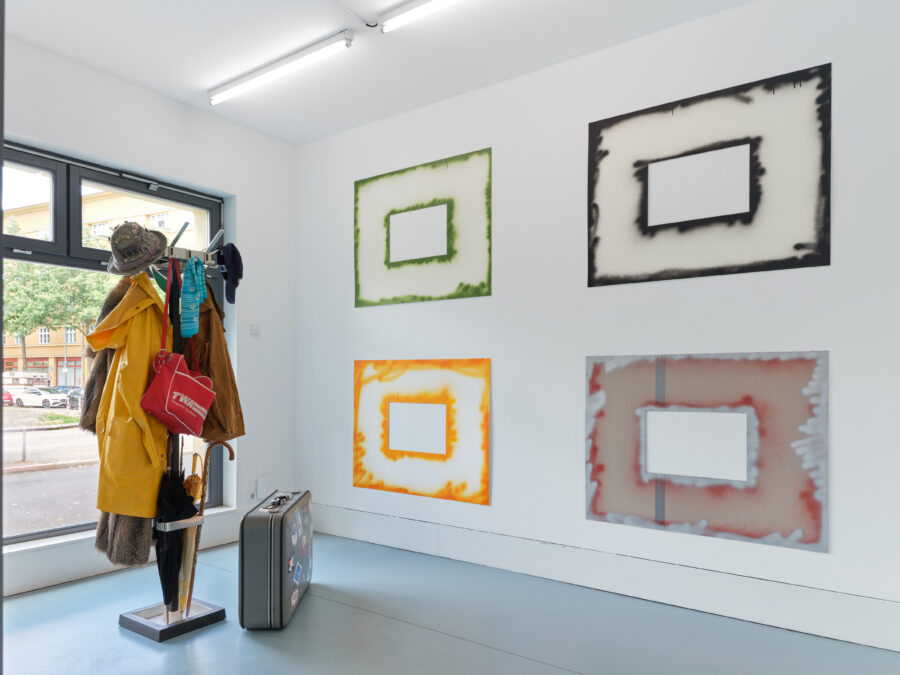
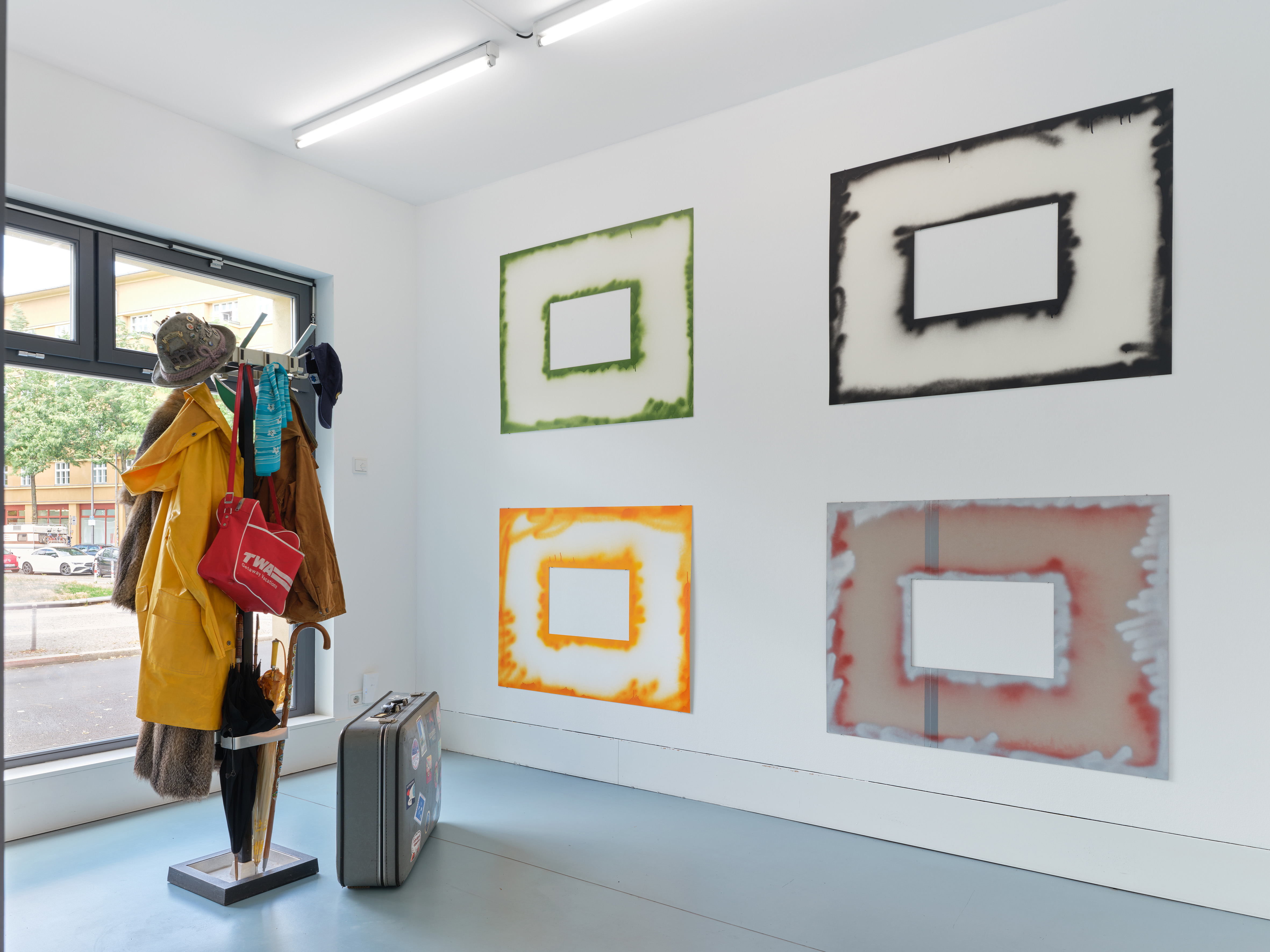
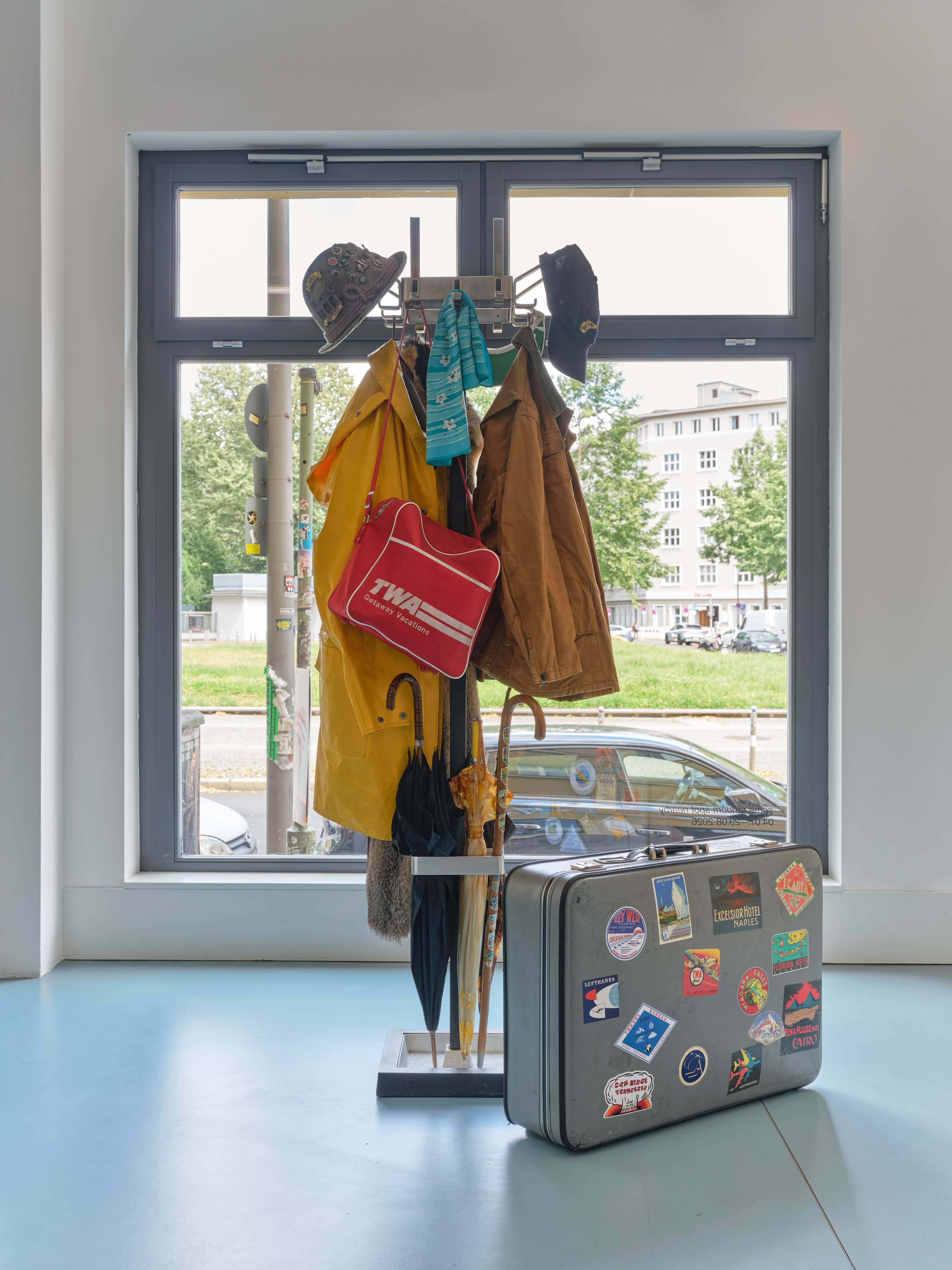
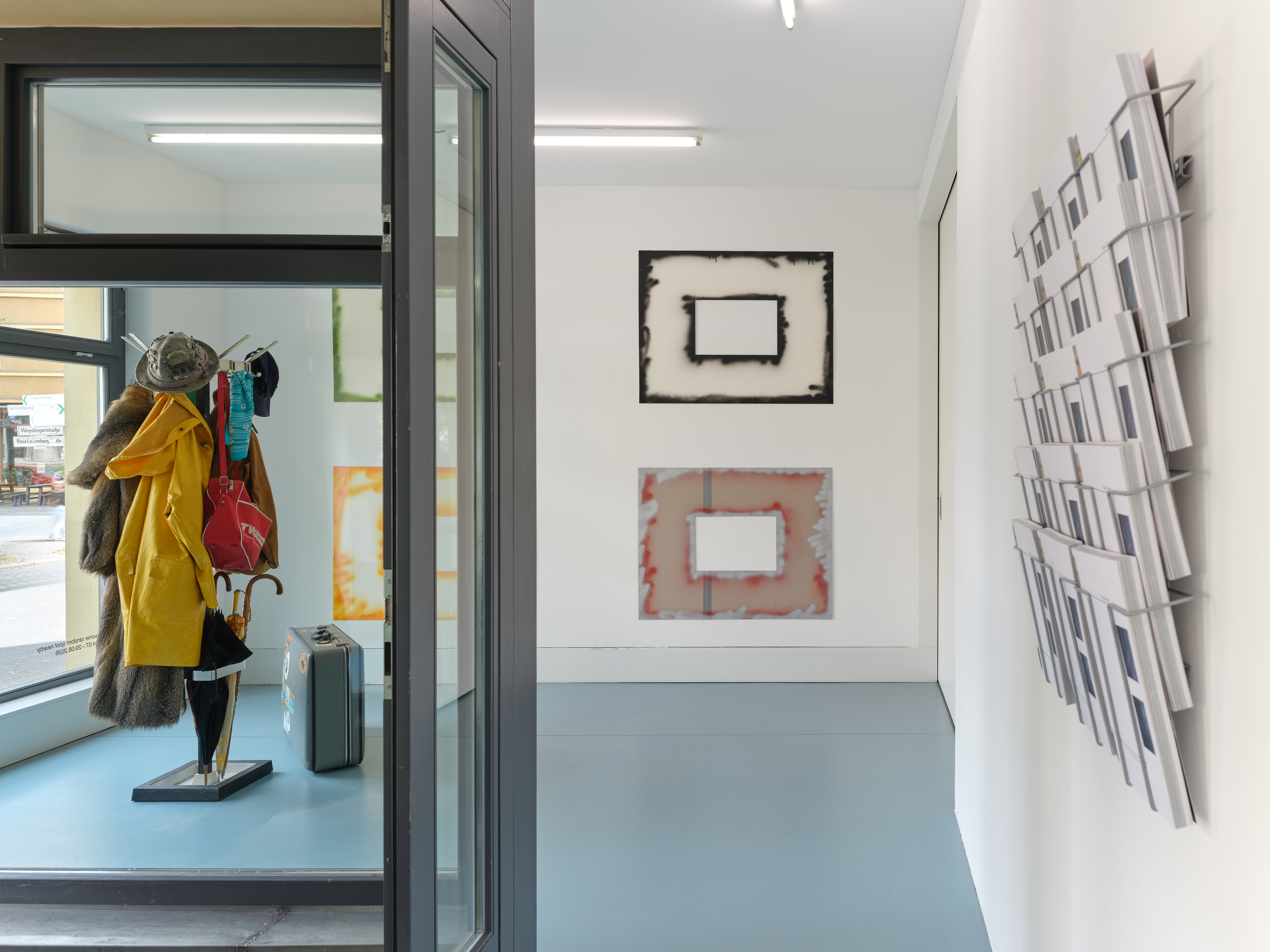
Mark Dion’s Coat Tree – Travel Bureau (2026) is a replica of a coat stand from the Travel Bureau installation, this time with various new elements added to create a new sculptural work, in a sense a distillation of his extensive 2023 installation. Historical garments and accessories evoke forms of movement, travel gear, and the attitudes and economic circumstances behind them, bringing to mind different climate zones and regions of the world. A collection of hatpins, medals, and stickers represents travel routes, destinations, festivities, landscapes, and their tourist-oriented framing. One might also read the coat stand as a portrait of a classical natural-philosophical model for explaining the order of the world.
In his practice, Dion explores humanity’s relationship with nature, the practice of collecting, and the cultural representation of the environment. His installations, often reminiscent of natural history displays, are composed of meticulously arranged found objects, sculptures, and photographs. These works challenge traditional narratives of science and history, questioning claims to objective truth.
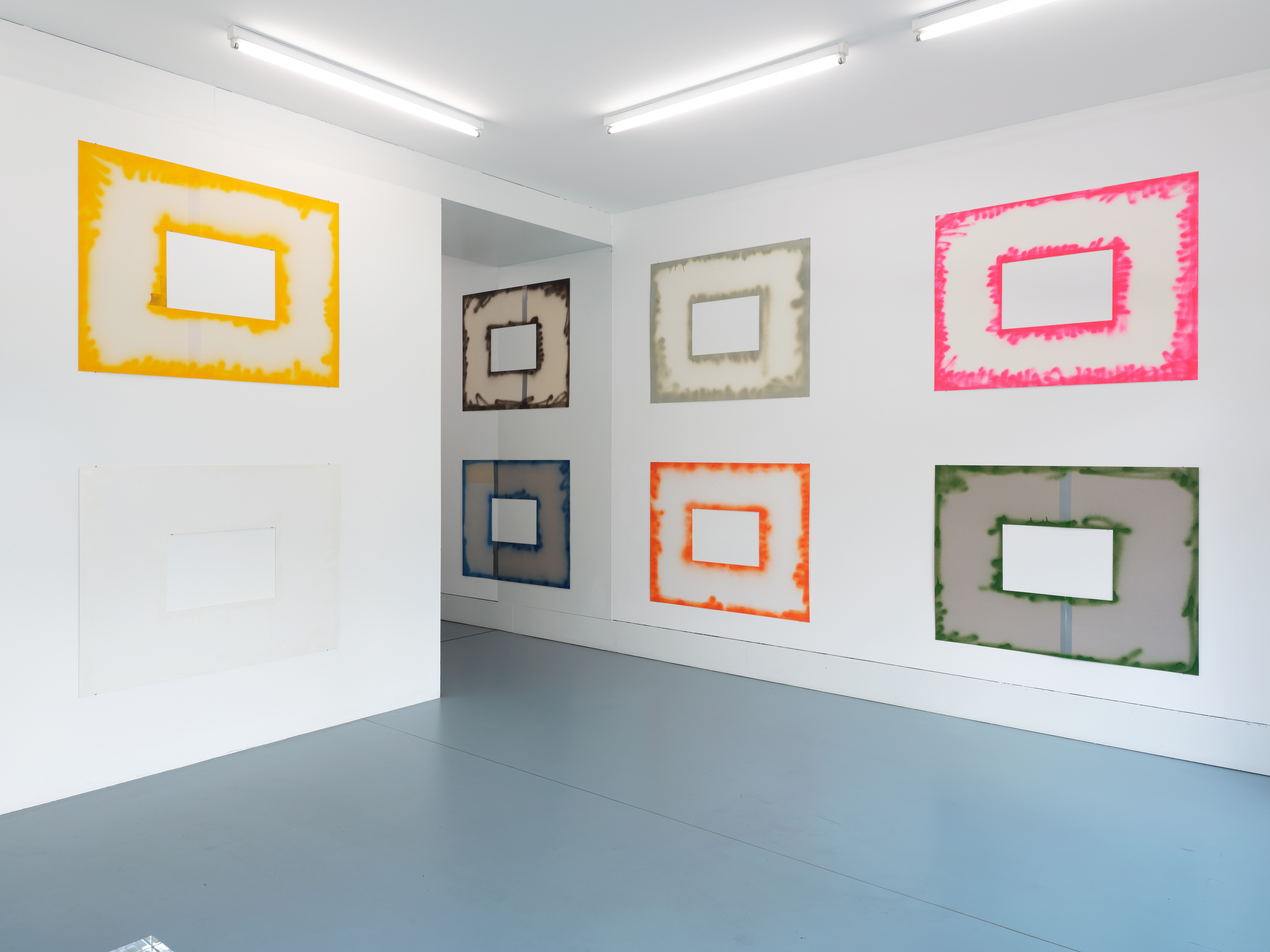
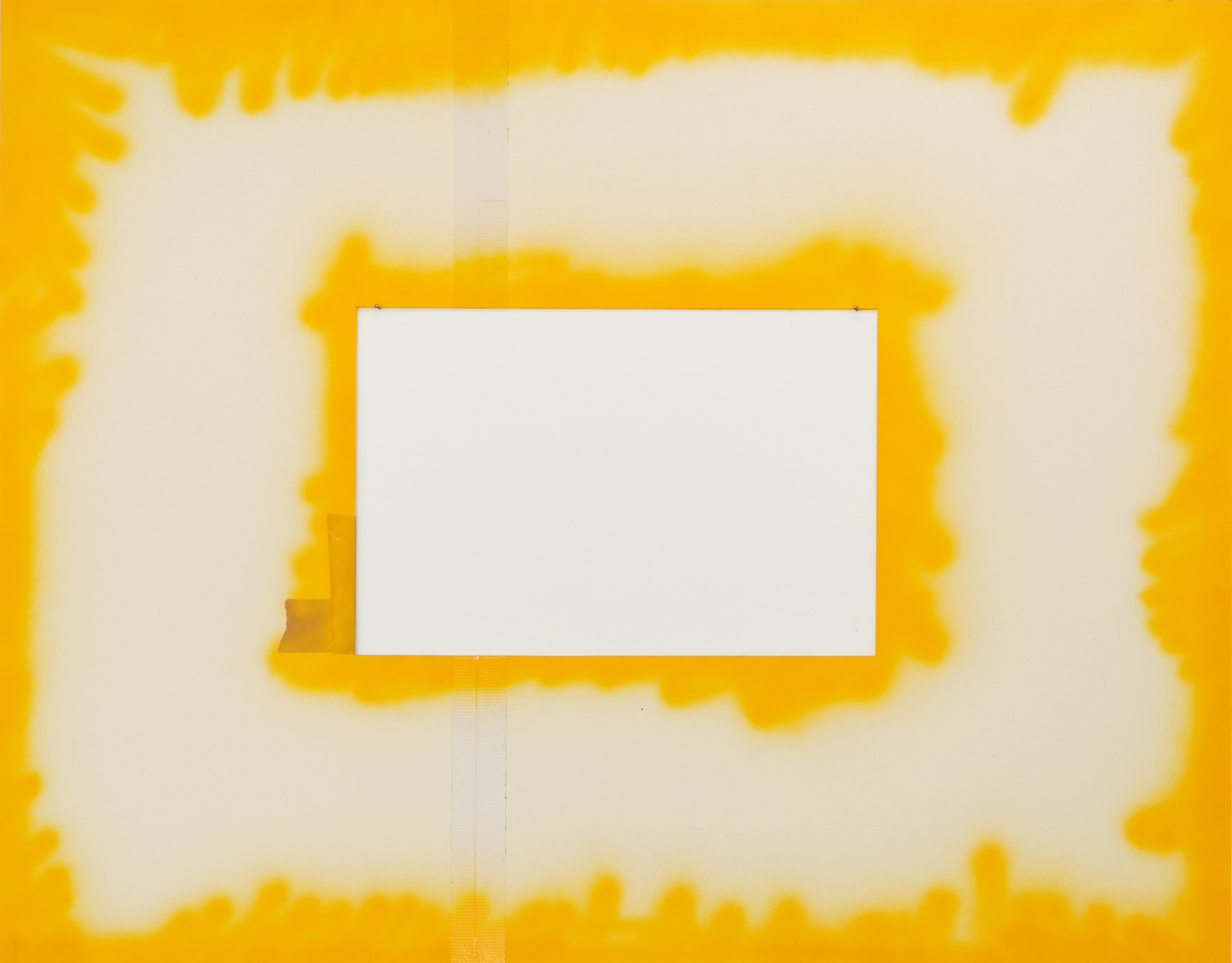
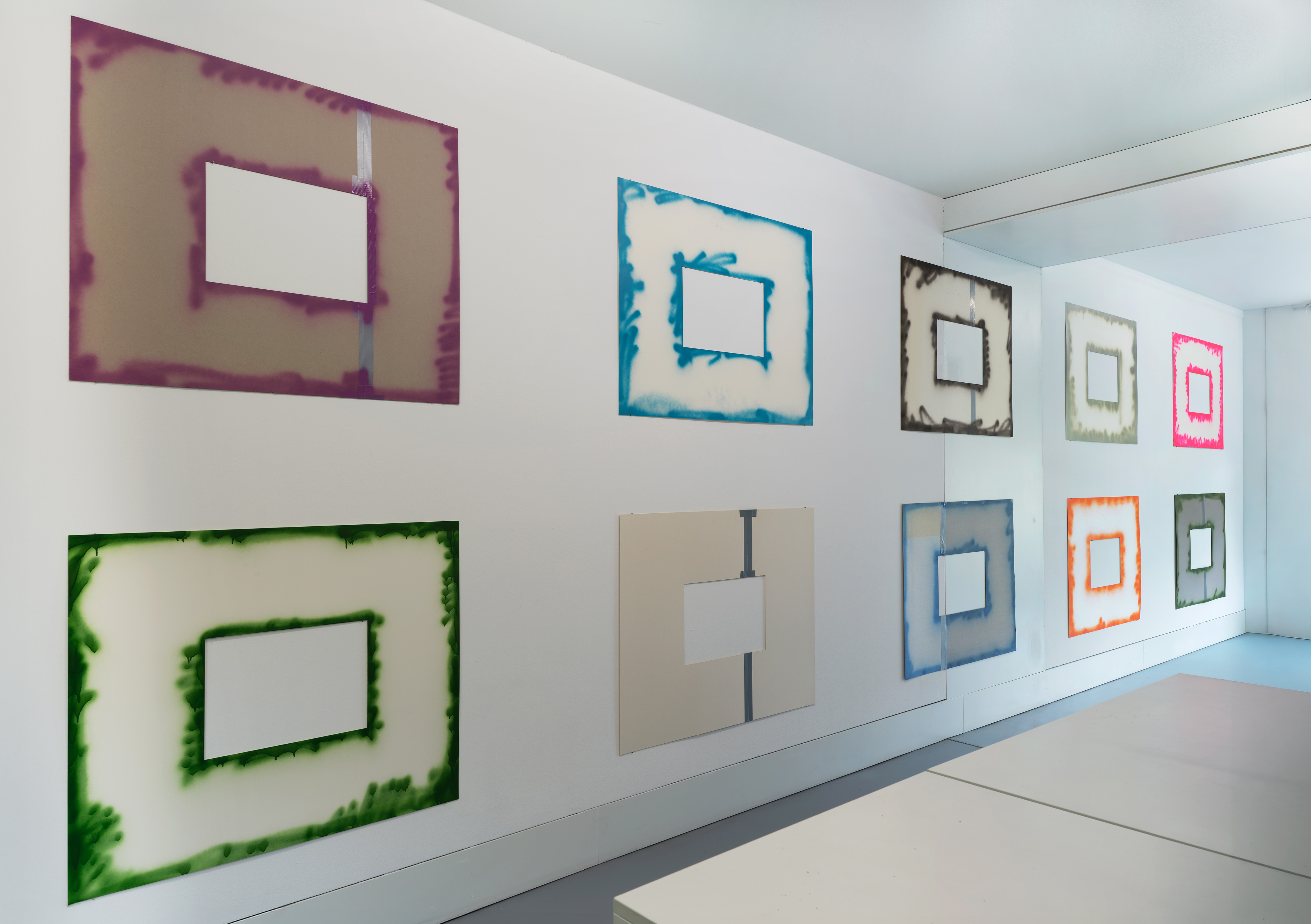
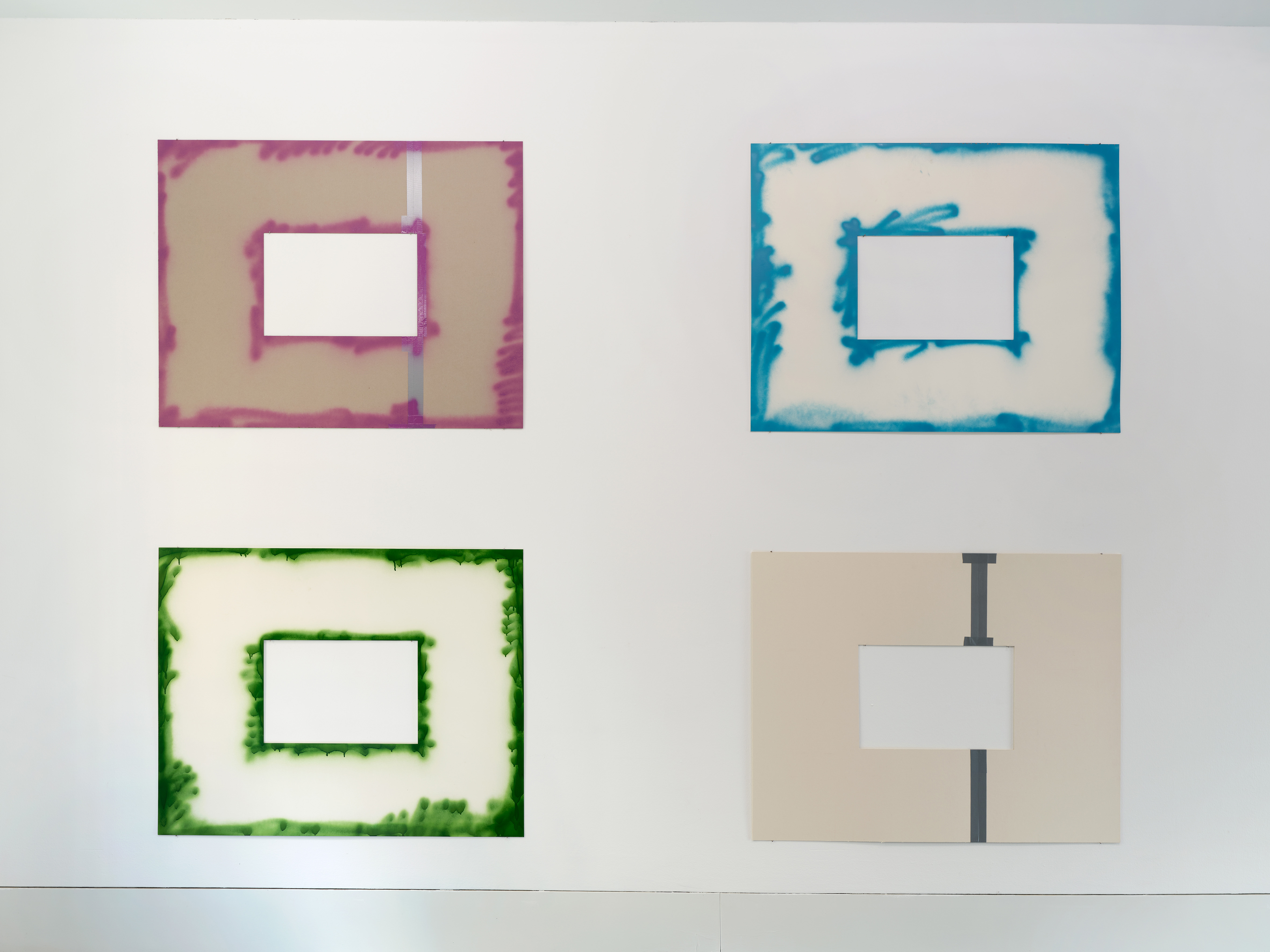
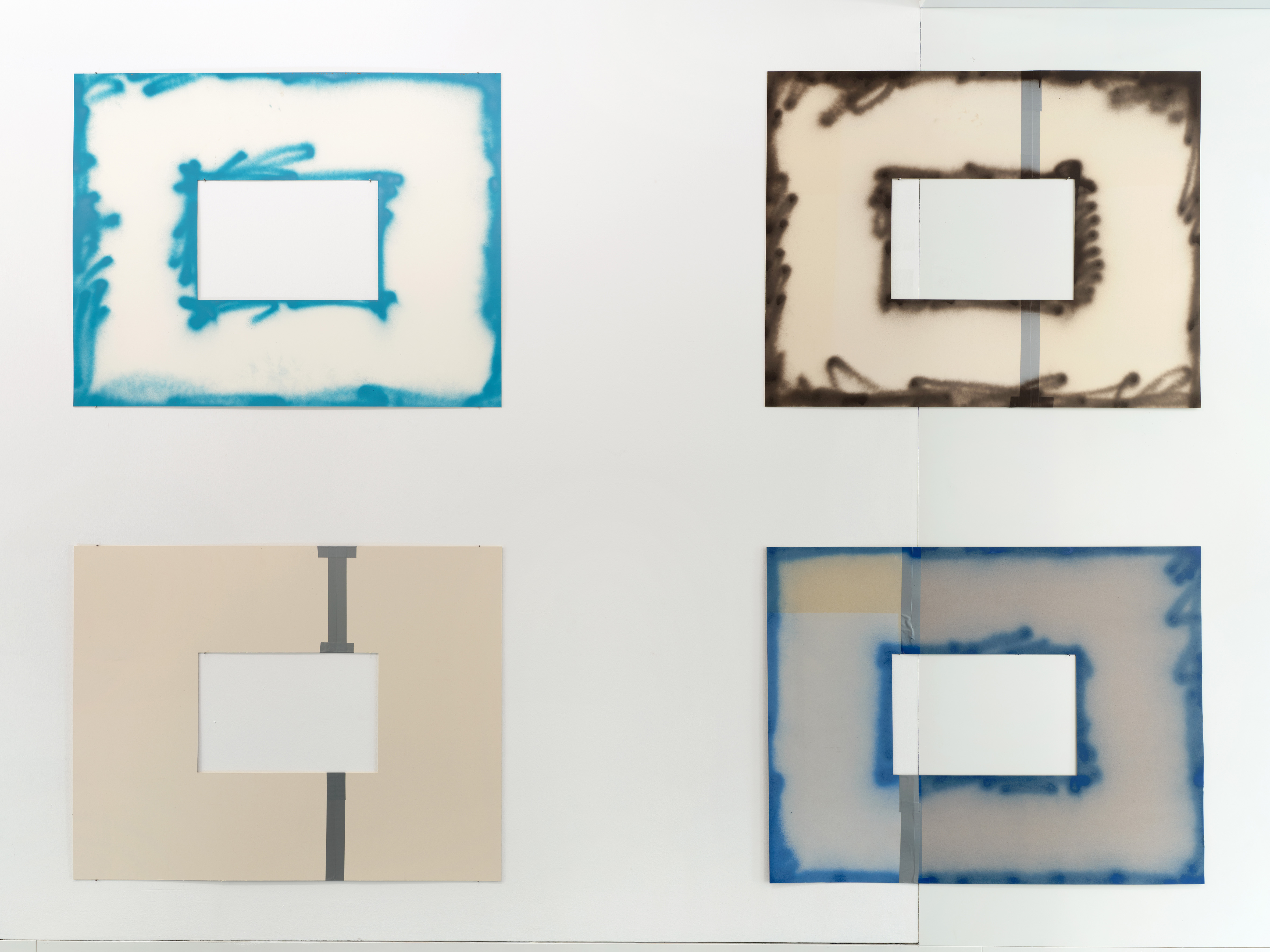
Till Krause presents Spray Paint Stencils (2026), a series of seventeen pieces made from cardboard, each titled according to its dimensions. These measurements refer to a footnote[3] in the publication in which Krause elaborates on the dimensions of Maier-Reimer’s photographs and their frames, as well as the specific proportional relationship between image, frame, and exhibition space – or, when sprayed outdoors, between an image zone and urban/rural space. The works draw attention to the unusually wide margins in which the frame strips enclose the photographs. The simple stencils suggest both containment and extension, implying a process in which the central area would be defined in a specific ration and remain widely unpainted, while the surrounding wall is spray-painted, continuing into infinity. Krause shifts the attention from the image itself to the spatiality that defines and presents it. A thematic Krause explores also in his overall oeuvre, the series questions how space is measured, interpreted, and transformed through observation.
Till Krause lives in Hamburg. In collaboration with the artist project space GFLK Galerie für Landschaftskunst and through other cooperations, he works on artistic concepts of urban and landscape spaces. Long-term projects include Free River Zone, Land for Five Final Acts, Hamburg Mapping Project, and Illegalevecht.
Mirjam Thomann lives in Berlin. Her exhibition “Theory & Action” was on view in 2022 at Galerie Nagel Draxler in Cologne, the solo show „Alliance“ has been presented at the gallery in Munich in 2023. In 2022, Thomann exhibited together with Nora Schultz at Klosterruine in Berlin. Her writings have been published with Texte zur Kunst a.o. She is a Professor for Artistic Practice with an Expanded Concept of Material at the Department of Art and Music at the University of Cologne.
Mark Dion lives in Copake, New York. His work has been exhibited at major museums and biennials worldwide, including the Museum of Modern Art, Tate, Centre Pompidou, and the Guggenheim Museum, as well as the Venice Biennale and documenta. His works are held in the permanent collections of leading institutions, including the Museum of Modern Art, Tate, Centre Pompidou, the Smithsonian American Art Museum, and the Museum of Contemporary Art San Diego.
[1] Dion, Mark, and Maier-Reimer, Daniel. Travel Bureau. Edited by Till Krause. Salon Verlag & Edition, 2025.
[2] The exhibition was titled Four Journeys by Daniel Maier-Reimer as Presented by Mark Dion and was on view at Clages Gallery, Cologne, between 05.05.2023 – 17.06.2023.
[3] p. 8 in Dion, Mark, and Maier-Reimer, Daniel. Travel Bureau. Edited by Till Krause. Salon Verlag & Edition, 2025.